Real Estate Text Message Automation for Investor Lead Management
@realestateinvesting496
Real estate investors rarely lose deals because they never found a lead. More often, they lose deals because a lead went cold between the first touch and the fifth follow-up. That gap is where real estate text message automation earns its place.
If you work motivated seller leads, you already know the pattern. A property owner responds at 8:12 p.m. While you are driving. A probate lead says, “Maybe later.” A tired landlord asks for an offer, then disappears for three weeks. A code violation owner clicks a PPC ad, fills out a short form, and expects an answer fast. The investor who replies first does not always win, but the investor who follows up consistently wins far more often than the one relying on memory, sticky notes, or a single VA with an overloaded inbox.
That is why automated SMS for real estate investors has become less of a novelty and more of an operating system. It gives acquisitions teams a way to handle speed, volume, timing, and persistence without sounding robotic or letting hot opportunities slip through the cracks.
There is also a practical distinction worth making early. Real estate SMS automation is not the same thing as blasting a giant list with generic seller text messaging. One is a lead management discipline. The other is just outreach. Investors who treat text message marketing real estate as a one-step tactic usually run into poor engagement, weak data hygiene, and compliance headaches. Investors who treat automated text messaging as part of a real estate follow up system tend to build healthier pipelines and better conversations.
Where text automation fits in an investor lead machine
Every investor has some version of a funnel, whether it is written down or not. Leads come in from direct mail, SEO, PPC, referrals, cold calling, driving for dollars, property owner lookup, or bulk skip tracing. Then someone has to respond, qualify, nurture, schedule, re-engage, and decide when to move a seller forward or step back.
Texting works well in the middle of that process because it matches how many property owners actually communicate. It is quick, low pressure, and easy to revisit. A seller who ignores a call may answer a text. A seller who will not fill out a long web form may still reply, “yes, interested,” or “call me tomorrow.”
For that reason, real estate investor texting should not sit off to the side as a separate marketing toy. It should connect to your real estate investor CRM, your pipeline stages, and your lead records. Otherwise the team ends up with scattered conversations, duplicate contacts, and no reliable view of seller motivation.
The strongest setups usually tie several actions together. A new lead enters the system, gets an immediate acknowledgment, receives a short qualification prompt, and then moves based on the seller’s response. If no one replies, seller lead follow up continues on a sensible schedule. If the seller re-engages weeks later, the conversation history is still there. That continuity matters more than people think. Motivated seller follow up is often won by context, not just persistence.
The real job of automation is not sending, it is sequencing
A lot of investors start with the wrong question. They ask which SMS automation software can send the most messages. That is understandable, but it misses the real operating challenge.
The hard part is not sending a text. The hard part is deciding what should happen next, for which lead, at what moment, through which channel, and with what tone. That is the heart of real estate lead management.
A decent automated lead follow up system should help you answer practical questions like these. Did this lead come from inbound real estate lead generation or from outbound prospecting? Did the owner ask for an offer, ask to be called later, or just go silent? Is this a fresh PPC inquiry that needs speed, or a colder list-based contact who needs gentler pacing? Has the acquisitions manager already spoken to them? Did they opt out? Are they in a market where timing windows make local-time compliance especially important?
Once you start thinking in sequences instead of sends, the value of real estate automation becomes clearer. The goal is not to replace judgment. It is to preserve it, then execute it reliably.
Why investors miss revenue without automated SMS
A human team is almost always worse at repetitive follow-up than it believes. Not because the people are lazy, but because acquisitions work is messy. Reps spend time on calls, appointments, comps, offers, title issues, internal updates, and dead-end conversations that looked promising on Tuesday and vanished by Friday.

That is where seller lead automation quietly does its best work. It handles the repetitive but important touches that human teams neglect first. The first acknowledgment. The callback confirmation. The “just checking whether you still want to sell” nudge. The post-missed-call text back. The appointment reminder. The reactivation message after a stalled negotiation.
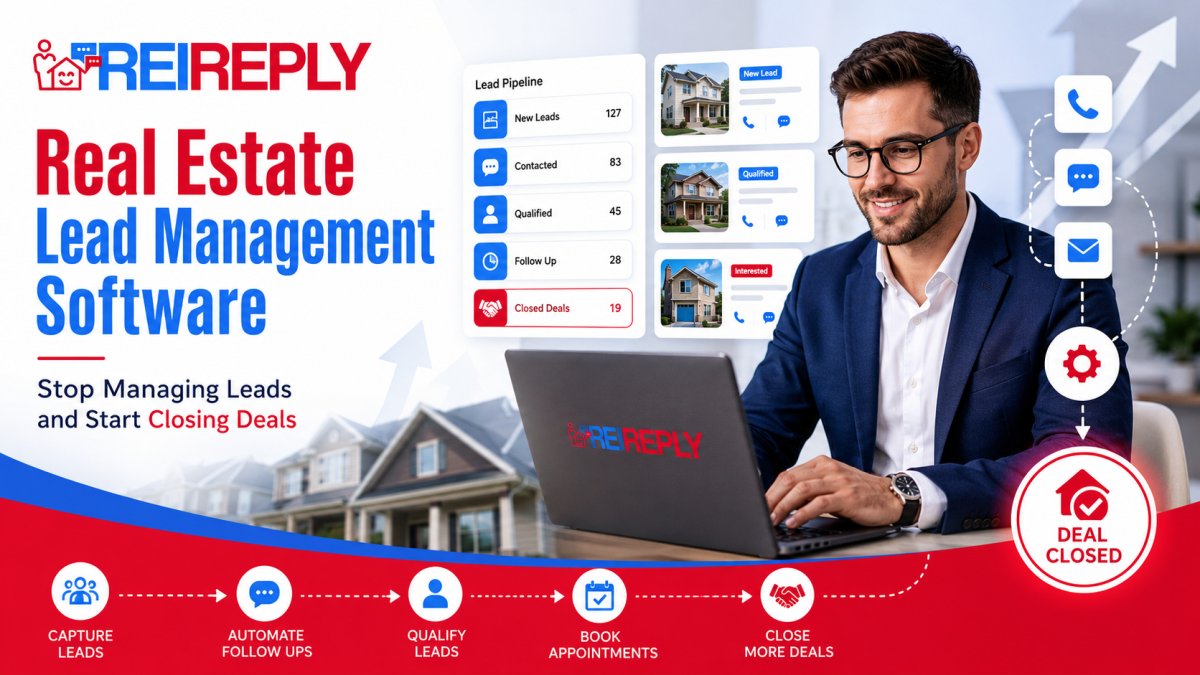
REI Reply has positioned itself around this exact operating problem. It describes itself as an investor-focused CRM and follow-up system built specifically for real estate investors, combining inbound and outbound calling, SMS, missed-call text back, and AI voice assistants in one platform. That matters because investors do not need a generic small-business texting tool nearly as much as they need a conversion engine that reflects investor workflows. According to its own materials, the platform is built for wholesalers, fix-and-flippers, buy-and-hold investors, and acquisitions teams running channels like PPC, SEO, cold calling, or SMS outreach. It is not pitched as a lead provider in the usual sense, but as a system to convert leads already being generated. At the same time, its subscription is said to include access to verified motivated seller data through REI AI Leads.
That positioning reflects a truth experienced operators already understand. Real estate investor software only matters if it shortens response time, improves follow-up consistency, and keeps the sales pipeline clean enough for someone to take action.
What good real estate SMS automation actually does
You can evaluate most platforms and workflows by whether they improve these five functions:
- immediate response to inbound seller inquiries
- structured seller lead follow up over time
- clear handoff from automation to a human acquisitions rep
- centralized conversation history inside the CRM
- reactivation of older leads without rebuilding context
If a system cannot do those things well, it may still send texts, but it is not solving the lead management problem.
The best CRM for real estate investors is not automatically the one with the most features. It is the one that supports your team’s pace and deal structure. A solo wholesaler in one county has different needs than a multi-market acquisitions team managing off market property leads, distressed seller leads, and referral volume across several campaigns. Some teams need stronger real estate sales pipeline visibility. Others need better AI lead follow up, or tighter coordination between SMS follow up and calling.
Automation works best when the first messages sound human
This is where many investor teams sabotage deliverability and response rates. They build an elaborate real estate SMS marketing system, then fill it with stiff, promotional, or obviously templated copy.
Property owners can tell when a message sounds mass-produced. So can carriers, at least often enough to affect text message deliverability. That does not mean every text has to be custom typed by an acquisitions rep. It means your automated SMS should sound like something a competent person would actually send.
A practical seller message is usually short, specific, and easy to answer. It does not try to close the deal in one shot. It opens the door to a conversation. In investor terms, it should uncover seller motivation, timing, and preferred next step. That is a lead qualification objective, not a copywriting stunt.

This is one reason platforms now talk about features related to messaging variation and humanized delivery. REI Reply, for example, advertises workflow features such as AI conversations, lead management, automated follow-up, Spintax, and Humanizer or text-deliverability-oriented messaging features. The promise is straightforward. Help investors maintain scale without making every message look identical or mechanical. Used carefully, that can support real estate SMS deliverability and more natural seller interactions. Used carelessly, it can become noise at scale.
The difference lies in restraint. Short messages beat clever ones. Clear messages beat aggressive ones. A seller who is actually considering a sale does not need theatrical copy. They need confidence that someone competent will respond.
The handoff point matters more than most teams realize
There is a point in every seller conversation where automation should step back and a human should step in. Strong real estate investor follow up systems are designed around that moment.
If a seller says they are ready to discuss price, timing, tenants, repairs, or title issues, a real acquisitions specialist should take over. If the seller is vague, curious, or unresponsive, automation can continue to nurture. That line is not always clean, but it is essential.
This is where AI lead qualification and AI seller conversations can help, if used with judgment. REI Reply states that its AI voice agent can qualify leads, book appointments, and follow up around the clock across calls, SMS, email, and social channels. In practice, that suggests a useful role for voice AI for real estate investors and AI phone agent real estate workflows, especially when teams want coverage after hours or during high lead volume periods.
Still, the objective is not to hide the human. It is to reserve human attention for the part of the pipeline where nuance matters most. A seller deciding whether to accept a discounted cash offer is not just a data point. They may be stressed, skeptical, grieving, angry at a tenant, or simply overwhelmed. No serious investor should forget that. AI follow up and automated lead qualification can organize the front end, but trust is still built in conversation.
Compliance is not a side note
Many investor teams talk about deliverability before they talk about compliance. That is backward.
If you are using SMS for real estate investors, calling, or other contact strategies at scale, the compliance framework has to come first. In the United States, A2P 10DLC is the carrier standard for application-to-person SMS traffic sent through 10-digit long code numbers, designed to ensure messages are verified and consensual. For investors using automated real estate texting, A2P 10DLC registration is not administrative trivia. It is part of the infrastructure that supports business texting compliance and message legitimacy.
There are also Telemarketing Sales Rule issues that acquisitions teams cannot treat casually. The FTC says telemarketers must honor Do Not Call rules, cannot use National Registry or entity-specific Do Not Call lists for any purpose other than compliance, and generally may not call outside 8 a.m. To 9 p.m. Local time without prior consent. The FTC also says prerecorded telemarketing calls require prior signed, written agreement, and that consent can be obtained electronically if E-SIGN requirements are met.
Even if your operation is heavily focused on real estate text marketing rather than voice, those rules shape how your broader outreach system should be designed. If you run real estate investor automation across channels, the safest posture is to build around consent, suppression discipline, local timing controls, and clean records. That is not glamorous, but it protects the business.
Data quality still determines outcomes
No amount of real estate AI, investor CRM logic, or automated SMS software can rescue bad lead data. If your numbers are stale, mismatched, or poorly sourced, your seller lead generation engine will underperform before the first text goes out.
This is especially relevant for teams doing skip tracing for real estate investors, property owner data work, or off market property prospecting. Real estate skip tracing, bulk skip tracing, and property owner lookup can all support lead generation automation, but only if the underlying real estate lead data is handled carefully. Investors often obsess over the message and ignore the list. In reality, list quality and message quality are partners. Weak data creates weak conversations.
There is also a workflow implication here. Good investor CRM systems should not only store a phone number. They should preserve source, status, contact attempts, responses, and next action. That is what lets an acquisitions team learn over time which lead sources actually create seller conversations and which ones only create activity.
A practical workflow that does not overwhelm the team
When I have seen real estate follow up automation work well, it usually follows a simple discipline. Fast acknowledgment, light qualification, persistent nurture, clean escalation. Not ten dozen branches. Not a giant maze of if-then logic no one can debug. Just enough structure to keep leads moving.
A workable setup often includes these checkpoints:
- every inbound seller lead gets a prompt first response
- unresponsive leads receive spaced follow-up, not constant pressure
- qualified replies trigger a human callback or appointment workflow
- older leads are reactivated periodically with context-aware messaging
- opt-outs and do-not-contact records are enforced immediately
That framework supports both motivated seller lead generation and real estate lead nurturing without turning the CRM into a science project.
The common failure mode is overbuilding. Teams create overly complicated sequences because the software allows it. Then no one remembers which automation fired, why a seller received three messages in one day, or who owns the next action. A cleaner system usually performs better because the team actually trusts https://reireply.com/post/real-estate-investor-contact-center-software-the-2026-guide-to-ai-dominance-2 it.
Where REI Reply fits for investor operations
Investor-specific platforms exist because general CRMs rarely understand how real estate acquisitions really work. The investor world has its own timing, terminology, and handoff points. Wholesalers, flippers, landlords, and acquisitions managers need rapid follow-up, a real estate sales pipeline tied to seller intent, and communication tools built around inbound and outbound lead conversion.
REI Reply has been positioned as that kind of investor CRM. Its materials present it as a CRM and follow-up platform for investors, not simply a text sender. It combines channels such as calling, SMS, and missed-call text back, and it also promotes AI voice assistant capabilities. For teams juggling SEO leads, PPC leads, cold calling outcomes, and SMS lead generation, that all-in-one framing makes sense. It addresses a familiar investor pain point, which is that every disconnected tool creates another place for lead leakage.
That does not mean a platform alone fixes operations. You still need message judgment, lead routing rules, stage definitions, and standards for seller lead follow up. But an investor-focused CRM can make those standards easier to enforce. It can also reduce the lag between interest and response, which is often where deal value evaporates.
The subtle advantage of missed-call text back and always-on coverage
One underappreciated function in real estate lead management is what happens when nobody answers. Many motivated seller leads do not arrive neatly between 9 and 5. They come in during dinner, on weekends, or while someone is already on another line.
A missed-call text back feature helps close that gap. It gives the seller immediate acknowledgment and preserves momentum long enough for a real person or AI assistant to re-engage. That is not flashy, but it is operationally valuable. It tells the lead they were not ignored.
Likewise, always-on coverage through an AI voice agent can help capture intent outside normal working hours. REI Reply says its AI voice agent can qualify leads, book appointments, and continue follow-up across multiple channels 24/7. For investors who miss opportunities simply because speed-to-lead slips overnight, that kind of capability can be meaningful. The caveat is the same one that applies to all automation. If the logic is weak, or the handoff is unclear, round-the-clock coverage can create round-the-clock confusion.
What investors should watch as they scale
The transition from a few dozen leads per month to a few hundred changes everything. Manual texting breaks. Memory-based follow-up breaks. Loose pipeline discipline breaks. At that point, real estate marketing automation is no longer optional if you want consistency.
But scale introduces new risks. Teams start prioritizing volume over relevance. They ignore SMS carrier filtering until deliverability slips. They pile voice AI, SMS, email, and lead routing on top of old habits without cleaning up the underlying process. Then they wonder why the dashboard looks busy but closings stay flat.
A healthier way to scale is to keep asking operational questions. Are we responding faster? Are we booking more real conversations? Are we nurturing older seller leads instead of letting them die? Are we documenting motivation and timing? Are we respecting compliance requirements and consent? Those questions keep the focus on outcomes, not feature count.
The investors who benefit most
Not every operator needs the same level of automation. A part-time investor doing a handful of deals a year may only need simple texting and a basic follow-up rhythm. But once you are running multiple lead channels, managing an acquisitions team, or trying to improve conversion from motivated seller data, real estate text message automation becomes much harder to ignore.
It is especially useful for teams that already generate leads and suspect the real problem is follow-up execution rather than top-of-funnel volume. REI Reply itself describes its role as a conversion engine for leads already being generated, which is a useful lens. Many businesses do not need more names. They need fewer leaks.
That is the practical promise of automated SMS for real estate investors. Not magic. Not effortless deal flow. Just a better system for answering on time, staying in touch, qualifying intelligently, and keeping opportunities alive long enough for a good acquisitions rep to do the human part well.
When real estate investor texting is handled that way, it stops being just another marketing channel. It becomes the connective tissue between lead generation, seller conversations, and signed contracts.